Showing posts with label heirloom vegetables. Show all posts

Wednesday, February 6, 2013

Free Seed Giveaway

Along with Classical Formulas, I'm doing a free seed give away. You can find details about the seeds being given away and how to enter here.

Hurry and enter by midnight 2/28/13!

We've passed the half way mark to the Spring equinox. So enjoy the second half of winter and dream of spring planting!

-kim

Thursday, January 31, 2013

Tuscarora Bread Beans

Left: Tuscarora Bread Bean;  Top: Romano Pole;  Right: Seneca Speckled Egg
I'm always excited to be trying out new heirloom varieties in the garden but I'm really excited to try the Tuscarora Bread Bean, a Native bean variety, this year. Read my newest article for more about it as well as links to the bean bread recipe and info on a source for the seeds:

Our Green Neighbors Blog

Enjoy and dream of spring!

-kim

Tuesday, January 22, 2013

Planting pole beans this year?

If you are not planning on doing a 3 Sisters garden style of planting for the pole beans in your vegetable garden this year, you may like my recent article on a companion underplanting for pole beans. It was a lucky happenstance for me last summer and I plan to do it again this year.

You can find the article on my blog. Enjoy!

-kim

Tuesday, September 25, 2012

Gardening

Left- black bean picked off green vine. Pod moist and still growing. Right- same black bean picked off dried withered finished growing vine. Both picked before the first frost.  Note: notice the hydration loss from the bean on right. Tomorrow We will post an after picture of both. We will note the hydration loss from the one on the left.

From the Garden

Cherokee Trail Of Tears. Black bean.

Thursday, August 16, 2012

The Iroquois White Corn Project

Iroquois White Corn
by Amy Brandlin and Lou Sinesio

The Iroquois White Corn Project got into full swing this summer. We processed and packaged about 100 pounds of corn flour and whole white corn. The one pound bags were sold at the Ganondagan Dance and Music Festival in July.

What is Iroquois White Corn?

The Iroquois White Corn is a special variety. It is especially significant, because the corn plants are descendents of the corn which was grown by the Haudenosaunee who lived in the town of Ganondagan in the 1600's. The French military torched the stores of grain, but all the corn was not destroyed in the fire. Generations of Seneca men and women have continued to grow this variety, saving the genetics.  This corn is now grown all over the region by Haudenosaunee farmers who meet regularly to exchange seeds and talk about issues related to their crops. We began the project in part to build a sustainable market for them.

Iroquois White Corn
Most people, when they think of corn, picture in their mind "sweet corn." Sweet corn is sold fresh, processed in canneries, and sold as frozen corn. Field corn (not sweet and usually the "Number 2 Dent" variety) is used as feed for chickens, cows and pigs and in the production of corn syrup, and corn meal. If you are driving and looking at the corn fields in the area, it is probably Number 2 Dent corn that you are watching grow. The growing of so much Number 2 Dent has created what is known as a monoculture. Monocultures are not good for any species. Variety is the spice of life, but also it is important for the survival of a species. Genetic diversity within a species creates strength against disease and adaptability to environmental changes. Typical American agricultural practices today have largely created a corn monoculture. The Native American agriculture, however, is very diverse with many types of maize or corn. The focus of the Iroquois White Corn Project is the Iroquois White corn variety. The seeds are shared and exchanged throughout the community, ensuring adequate genetic variability to ensure plant health.

Where Does the Corn Come From?

Native American farmers here in our region grew the white corn for the project. After being harvested by hand in the fall, it must hang to dry. For this, it is braided in the traditional way. After it has dried a few months, the kernels must be removed from the cob. This is done manually by pushing the kernels off the cob with one's thumb. Some people use a tool to remove the kernels.

How Is the Corn Processed?

If the corn is to be made into roasted white corn flour, it is roasted, ground and bagged. The White Corn Project uses a large coffee roaster for the creation of the Roasted Corn Flour product. The nutritional advantage to our white corn products is that the germ is not removed, so the products are whole grain. The flour should be refrigerated, as the oils in the germ need to be kept fresh. The germ contains vitamins and minerals, as well as fiber.

White corn to be used in soup or stew (as hominy) must be treated in a lye bath to remove the outer hull on each kernel. This process is known as nixtamalization. Many people follow the traditional way to create a lye solution with hardwood ashes. That is done by rinsing the corn using a corn basket, which is a traditional tool still made by Native basket makers. These baskets are constructed of ash splints that are sized and spaced specifically for the corn washing. Throughout the region, Haudenosaunee people are still using and teaching this method.

One of many hand-crafted steps in processing the corn
Many people though, find the work involved in preparing the corn in this manner difficult. And with modern hectic and busy lives, many people just do not have the time.  The White Corn Project is using a culinary lime or calcium hydroxide to create that lye solution. The corn is brought to a boil and simmered until the hull becomes loose and is able to be washed off. The treated corn is then rinsed in a wire basket with fresh water. We are also exploring reliable sources for clean hardwood ashes.

After the corn is rinsed free from the outer shell covering and the lye, and drained, it is placed in the dehydrator. The corn takes about 4 hours to dehydrate. These kernels are bagged to be sold as Hulled White Corn. To use in a soup or stew, they must be soaked overnight, drained and then cooked according to the recipe, until soft. After dehydration the corn can also be ground to into White Corn Flour. This flour can also be used as a substitute for corn meal or blended in combination with other types of flour in recipes.

Why Iroquois White Corn?

Besides connecting connecting people with local agriculture, the Iroquois White Corn Project also connects people with history and ancient traditions.

For some, it is also a personal connection with with their ancestors. As one of The Three Sisters, this corn is sacred to the Haudenosaunee people. We thought of Sister Corn as we finished up our work - her portrait hangs in our workspace and smiles down as if in appreciation.

Thursday, April 26, 2012

Wild Strawberries in Bloom

Wild Strawberry, Fragaria virginiana

One of the signs of spring has come, the blooms of the wild strawberry. The blooms herald the coming of the very tasty fruit.

If you would like to see more images as well as a video on how to identify wild strawberries, be sure to check out my new blog, Our Green Neighbors. It is dedicated to information on and images of our green friends and neighbors - the plants of our world.  

Of special interest to our readers here, Our Green Neighbors will regularly feature information on medicinal and native plants as well as heirloom vegetables - being that those are some of my favorite interests. It will also feature The Herb of the Week which will be a new article each week on a selected herb.

I'll still be writing for the Friends of Ganondagan blog, but I encourage you to follow me on Our Green Neighbors as well. Enjoy!

-kim

Monday, October 31, 2011

The Great Pumpkin Sacrifice

Over the weekend we made our "sacrifice" to the pumpkin gods and carved up our pumpkins for Halloween. What would Halloween be with out the carved jack-o-lantern? Not the same to be sure, but the pumpkin is a New World addition to the Halloween traditions that originated in Europe. Before the pumpkin, turnips or rutabagas were carved into the vegetable lanterns.

The pumpkin is a New World vegetable that has been cultivated by the Native peoples of the Americas since ancient times. While the exact origins of the pumpkin are not known, pumpkin-like seeds have been found in Mexico dating back to 7000 and 5500 BCE. With what the pumpkin has to offer why wouldn't it be grown for thousands of years? It is a very easy to grow plant that provides copious amounts of nutritious, long-keeping food (both the flesh of the pumpkin and its seeds.) And as with many food plants, there are medicinal uses and healthful qualities beyond the simple nutrition it provides.

Back to our carving of the pumpkins, not all of our parings went into the compost bin. We saved the seeds for toasting and the pieces carved out for roasting. Some like the pumpkin flesh roasted with salt and olive oil. In my opinion that would work well with a pie pumpkin but not so with the bland flesh of pumpkin grown for carving. (What's the difference?) A little salt, black pepper, butter, and brown sugar is the way to go - you have to give it some flavor and my favorite way to cook a variety of winter squashes fits the bill.

And if you have never toasted the seeds, what are you waiting for? These are truly divine! Here's a recipe for toasting your Halloween pumpkin's seeds:

Toasted Pumpkin Seeds
  • 2 c. Raw, whole pumpkin seeds
  • 2 Tbsp. butter, melted
  • Salt to taste
Wash the pumpkin seeds and drain well. Toss seeds with butter and salt. Spread the seeds in a single layer on a baking sheet and bake for about 45 minutes in an oven preheated to 300 degrees. Be sure to stir occasionally and toast until golden brown.

I hope you enjoyed this look at the pumpkin and perhaps you may now consider it to be more than just something for decoration and pies. I wish you a happy Halloween and a wonderful Samhain!

-kim

Wednesday, May 11, 2011

Come Join Us in the Gardens!

Invitation from our Gardening Committee chair, Tonia Loran-Galban:

Garden planting date has tentatively been set for Tuesday May 31st at 1:30pm meet at the garden with hoe in hand. Planting should take about 30-45 minutes, roughly. Come on over and introduce yourself. Note - Rain Date is June 1st.

If you cannot make the planting date but are interested in weeding (it is surprisingly low maintenance) please email me gardens@ganondagan.org and I will email you a map of the garden. Or if I'm on site, I will show you where to weed.

~Tonia

Update on May 31:
Dear Garden Friends- With temperatures going up to 90 to day, we thought it would be better to do the planting tomorrow morning at 7:30am.  We know this is a late change, so let us know if you can make it tomorrow! ~Tonia and Ronnie


About Gardening at Ganondagan:
It's a terrific way to get out and enjoy the sunshine, fresh air, and the feel of the rich, dark earth in your fingers. It doesn't matter if you are an experienced gardener or not, everyone is welcome to join in! Come and learn traditional Haudenosaunee ways of gardening - perhaps you will learn something for your own gardens!

Keep your eye on this blog for any changes to the planting date due to weather. Nya:weh! And see you in the gardens!

-kim

2011 Three Sisters Garden:

Wednesday, January 12, 2011

Welcoming the Green into Your Life

As I look out my window, I see the snow softly falling. It has snowed all day and has left our Mother Earth covered in a blanket of pure, unblemished white. Some find this cold season dismal and depressing. I don't. I know the Earth needs this quiet season to rest and I also know that many of our most beloved native plants and wildflowers need the conditions of the season so their seeds will germinate.
Native Corn Variety - Dakota Black Popcorn

But most of all, this time of the year is one in which I dream of warm sunny days and my fingers working the dark, rich earth. Yes, I am a gardener, a lover of green growing things, and a tender of the soil. Winter is a terrific time for planning gardens and starting seeds. I know my own mailbox has blossomed with all manner of seed, plant, and gardening catalogs.

January is often a time of new promises and goals for the year. I encourage everyone to add planting a garden this year to your list of 2011 goals. For those with health goals this year, please know that gardening is a terrific activity for your health - see an article I wrote here on this topic. Gardening also allows you to reconnect to millennia-old traditions of sowing seeds, tending the soil, and partaking of the fruits of your labor - whether you be a gardener of flowers, herbs, or vegetables. To help you in this endeavor, I'll share some of my favorite sources with you. All of these places have online store fronts and many have print catalogs free upon request.

My best wishes for you in 2011. May you find beauty, joy, happiness, and peace in your gardens and may that extend to the rest of your life. Namaste.

-kim


Vegetables/Food Crops

Heirloom Tomatoes from my 2010 garden
Nothing is better than a tomato fresh from the garden, still warm from the sun's kiss that is sprinkled with a little sea salt. And so I encourage everyone to grow their own foods. Many food plants are ornamental in their own right and can easily slip into your flower beds if you do not have dedicated vegetable spaces. I also encourage everyone to seek out heirloom/heritage seeds, some of which are of direct Native origins. These are wonderful and tasty departures from the bland and tasteless vegetables that crowd grocery shelves. They will certainly be at home in your 3-Sister Garden.

Abundant Life Seeds - Organic and biodynamic vegetable seeds
Baker Creek Heirloom Seeds - One of my favorite heirloom seed sources. Some Native varieties. The owners of Baker Creek recently bought the historic Comstock Seeds company.
Comstock Seeds - A 200 year old tradition of selling seeds being relaunched by new owners (website coming soon)
Johnny's Selected Seeds - A wide range of vegetable and herb seed. No genetically modified seed.
Miller Nurseries - A local company that specializes in fruit tree, shrubs, and plants. Get a variety of plants and varieties including strawberries and blueberries here.
Pinetree Garden Seeds - A favorite place to get not only a wide range of vegetable varieties but a place to get small amounts of seed for a small price which is a wonderful way to test out a variety
Raintree Nursery - All manner of fruit-bearing plants and trees are available here including juneberries, strawberries, and blueberries
Seed Savers - Heirloom vegetable seeds incl. some Native varieties
Seeds of Change - Organic vegetable, flower, and herb seed. Some Native varieties like the Dakota Black Popcorn I grew last year.
Territorial Seed Company - A wide range of heirloom, open pollinated, and hybrid vegetable varieties. No genetically modified or treated seed.
Totally Tomato - Can't find a particular tomato or pepper variety elsewhere? Find it here.
Terroir Seeds - Heirloom and open-pollinated seeds including the Cherokee "White Eagle" corn I grew in 2009. This special seed made the trip over the Trail of Tears.

Herbs/Medicinal Plants

White Baneberry - Poisonous & medicinal
Whether the herbs you grow are to season your food in the kitchen or are to keep you healthy, these are powerful members of the plant kingdom. Last week I had the pleasure to catch the podcast "Bringing Seeds to the People" by Richo Cech Herbalist and owner of Horizon Herbs. That combined along the current book I'm reading, Sacred Plant Medicine: The Wisdom in Native American Herbalism by Stephen Buhner has re-energized my desire to plant medicinal plants this season.

Horizon Herbs - Medicinal plants and seeds of many herbal traditions
Nichols Garden Nusery - A nice selection of culinary herb and vegetable seed
Richters - A wonderful source for medicinal plants of all sorts from nearby Toronto

Flower Gardening

I don't do much ornamental gardening these days but I do always slip some flowers into the vegetable beds to attract pollinators.

Select Seeds - Get antique flower seeds from this company including some of my favorite poppy varieties

Native Plants
Joe Pye Weed - A native beauty

I can't stress enough how important it is to welcome these plants into your life and gardens. Many have become rare in their native ranges. These plants are ideally suited to our growing conditions and they offer beauty, balanced habitats, medicines, and more. See plantnative.org for more details about growing native plants.

Forest Farm - While shipping from the westcoast is costly, this is a wonderful place to find many hard to find plants, trees, and shrubs.
Musser Forests - A nice place to get many native trees and shrubs in small amounts or quantity in nearby Pennsylvania
Prairie Moon Nursery - One of the best native plant and seed sources around.

Wednesday, August 11, 2010

The Three Sisters Garden

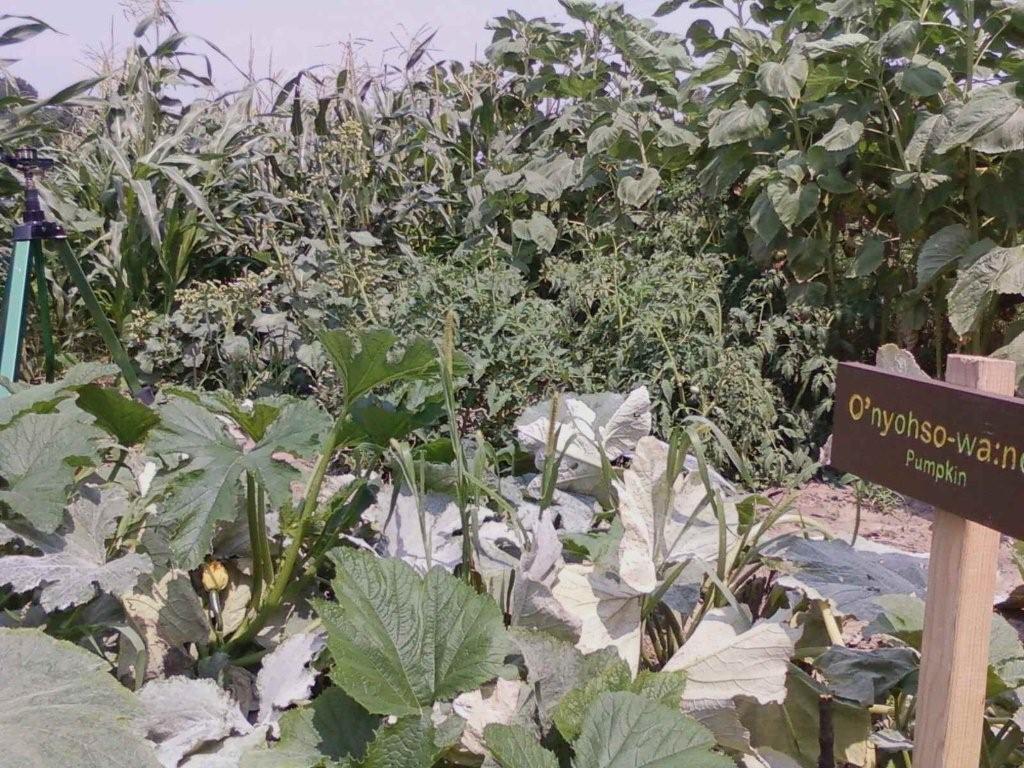
If you haven't been to Ganondagan and taken a look at the 3 Sisters Garden this season you should. It has been a truly wonderful season for the garden. Between the weather and all the effort put into it, the garden is stunning! This year the garden also features signs for the vegetables that have both the English and Seneca names.

Tonia Loran-Galban has took the following picture of the garden in which you can see how lush and vigorous the corn, tomatoes, sunflowers, and pumpkins are!

-kim

Monday, February 15, 2010

The Gift of Food

We have recently re-designed our Recipebox web page. It now has a greater focus on the foods indigenous to the Americas. Besides recipes, we also have a brief introduction to the history and origins of the food items. Some of the foods that were cultivated and harvested by the Native peoples of the Americas may surprise you. Did you know that the peanut and chocolate were first grown and harvested in South America and Central America respectively?

We have also doubled the number of recipes we are offering and have included images of the various food items. We hope you will enjoy this new resource and try some of the recipes. Also, be sure to check back often since we will be adding additional New World food items as well as new recipes!

Speaking of the traditions of food, I recently picked up a magazine that featured "heirloom," forgotten recipes - recipes that have been made for generations but have largely been forgotten. We all have recipes that have been passed down to us. I included one such recipe (Scalloped Corn in the corn recipe section). This recipe has been made in my family for at least 4 generations. It is a simple recipe that takes canned sweet corn - something put away during the harvest season and adds a few common farm-fresh ingredients to create a something-from-nothing dish. It is simple but tasty. And in eating it, you can appreciate the creativity of our ancestors to stretch what simple and sometimes meager food items they may have had into something more.

So in our re-launch of our Recipe pages, we would like to offer you the opportunity to submit your recipes featuring New World food items for possible inclusion in our Recipebox page. If it is a family tradition or if it has an interesting story that can be briefly shared, please feel free to send that along with your recipe. It is sometimes those bits of color and history that truly make the recipe! Send your submissions to us at friends@frontiernet.net. Thanks and enjoy!

-kim

Wednesday, January 27, 2010

Beat Those Winter Blues!

About this time of the year, the sun decides not to show its face very much. The weather gets gray...the ground gets gray...people get gray...I don't know why they call it the "winter blues." It should be more like the "winter grays!"

Thankfully, I'm an avid gardener and I think it helps me not succumb to those gray-times. Starting around Christmas, my mailbox is visited by the most wonderful things - the spring seed and plant catalogs! They are filled with pictures of plants that grow in green and sunny times. Oh, how I browse through those catalogs and dream of those halcyon days of Summer and my fingers working in the dark rich Earth!

Ok, I freely admit it, I am a plant-junkie. But you know, it's not a bad thing to be. I know how to grow my own vegetables. I know how to identify many of the plants and trees around me. I know many wild, edible plants as well as the poisonous ones to avoid. I know how to grow, harvest, and use many herbs, both culinary & medicinal. I know the "invasive" plants that should be eradicated for other flora as well as fauna. And best of all, I can share that knowledge with the young people in my life.

There's a quote in the video "Get 'em Outside" by the "No Child Left Inside" group that says young people can identify 1000 corporate logos but fewer than 10 plants and animals native to their backyard. That is sad. How can you care about the world around you when you know so little about it?

So here's my winter blues beater suggestion: plan to grow something this year. Start your planning now. Check out seed and plant catalogs - many places will send them to you for free. Even if you buy local (which I always suggest!), the catalogs are great ways to learn and plan.

If you haven't gardened before, start small. Try a patio tomato. Or some marigolds. Anything easy that has appeal for you.

If you live in an apartment or have limitations on your mobility, container gardening is just the thing. Here's a great forum to ask questions on container gardening.

Already a gardener? Grow some vegetables. They taste great and many are easy as well as attractive in the garden.

Veggies not your thing? Then try growing native plants. Native plants are the plants that are indigenous to this region. They are wonderfully hardy and ideally suited to grow here. If you are an experienced gardener, this symposium on designing with native plants may be of interest.

In all your planning, make sure to stay as "green" as possible. I wrote an article on green gardening, Things to Make your Garden Greener, that may help you get growing green.

And finally, please share the beauty and wonder of this great Earth with the young ones in your life. Or share with students at a local school, at a library, or perhaps even in a community garden. I have had the opportunity to present rocks & minerals, fossils, and wild edible plants to primary and elementary school kids. I can't tell you the excitement there was to see, to touch, and to ask questions. The students were fully engaged and learning. You don't have to be an expert - a little bit of knowledge and a whole lot of love for the subject matter is all you need!

So get planning and dreaming of warmer days to drive away those gray days of winter!


-kim

Tuesday, March 31, 2009

Want to learn how to make Seneca Corn Soup?

Or find out about the Canandaigua Treaty? Then check out the new Friends of Ganondagan videos page:

http://www.ganondagan.org/video.html

We have started our new videos page with some links to very good videos that others have created that we know you will find educational and interesting.

Eventually we will be adding our own videos to this page - so be sure to check back for them!


-kim

Sunday, February 22, 2009

February 22, 2009

This past Friday the staff of Ganondagan spent the day at the Tonawanda reservation. I was there to teach a class on cornhusk twined salt bottles. We were hosted by Jamie Jacobs and Ken Poodry in the firehouse building. We had a former ELDERS gathering attendee there as well as a good group of dedicated craftsmen/women.

The husks we brought came from our earlier work with Norton Rickard (Tuscarora) and his amazing Iroquois White Corn Farm. After braiding a couple dozen long ropes of corn I made sure we kept the remaining great long husks for such projects. It is essential to dry them well and store them away from rodents. The use of corn "by-products" fits so well into the cycle of Haudenosaunee lifeways and our intrest in cultural preservation. This year it seems we are ontrack for such activities.

The skill level required to make a simple twined cornhusk bottle is high. It is not for everyone. Twining is an ancient method of weaving which can be used to make husk moccasins, mats, bottles, bowls, & baskets. This workshop would introduce the concept of twining and hopefully get some Haudenosaunee artists using the techniques and materials.

At the close of the class two students had achieved containers and others were on their way to finishing the project! I was amazed at how quickly some people caught onto the concepts. It is good to see.

As the snows began to fall we decided to leave before it got worse and headed back to Ganondagan. We left behind a huge bag of cornhusks and hopefully the knowledge to work them.

Oneh ki,

Michael Galban