Wednesday, August 11, 2010

The Three Sisters Garden

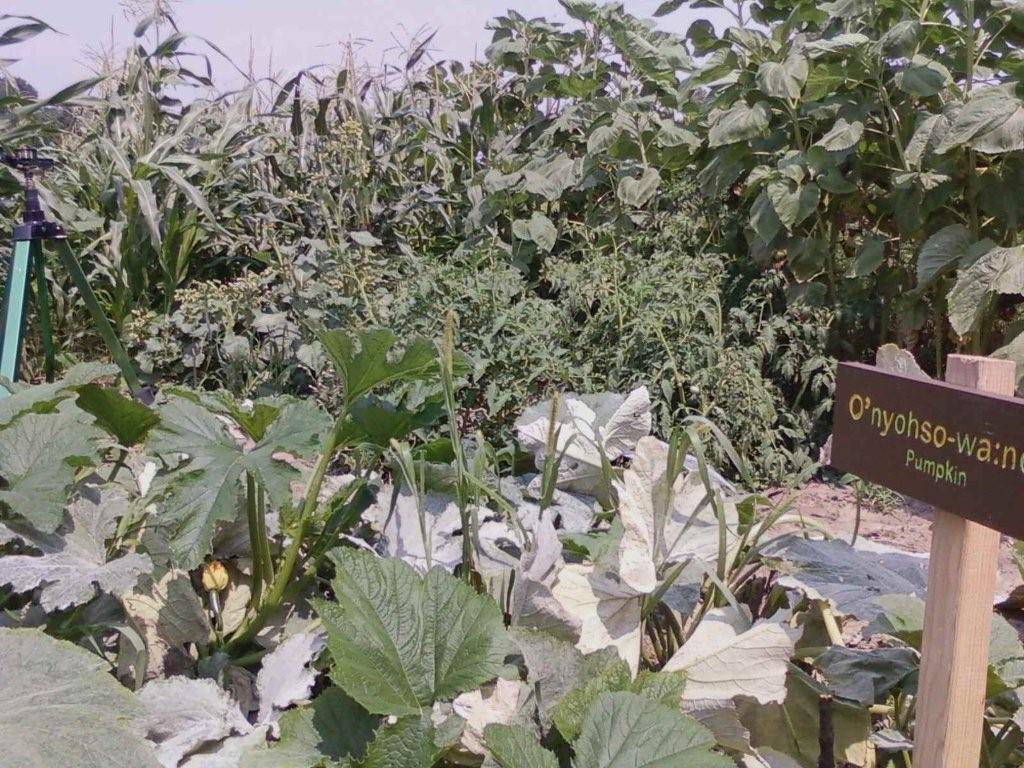
If you haven't been to Ganondagan and taken a look at the 3 Sisters Garden this season you should. It has been a truly wonderful season for the garden. Between the weather and all the effort put into it, the garden is stunning! This year the garden also features signs for the vegetables that have both the English and Seneca names.

Tonia Loran-Galban has took the following picture of the garden in which you can see how lush and vigorous the corn, tomatoes, sunflowers, and pumpkins are!

-kim

Sunday, July 18, 2010

Native American Dance & Music Festival and More!

Our Native American Dance & Music Festival is next weekend! We are excited because we think that this is one of the best festivals we have ever had! We think everyone will enjoy the Navajo Codetalkers and The Plateros not to mention all the other festivities we have planned. Please see our Dance & Music Festival webpage for the festival program which includes the complete festival schedule as well as information on the various acts and attractions, driving directions, and more.

If you visit our webpages, you will also notice a new icon/link on the left-hand side of the screen for Amazon. If you shop at Amazon, please consider navigating to Amazon via this link. Your shopping experience at Amazon is completely the same, but the Friends of Ganondagan can earn money from any purchases made.

We also have created a Ganondagan Online Store that features Iroquois and other Native American books, DVD's, and CD's. We have stocked the online store with suggestions from staff and friends for high quality items that our friends and members would enjoy. We even added a special Codetalker product page if you would like to read more about the Navajo Codetalkers or see one of the videos available. By the way - if there are books, movies, or music you would like to see us carry, please send us an email and let us know!

Thanks and hope to see you at the festival!

-kim

Tuesday, July 6, 2010

Native American Dance & Music Festival Video

Haven't been to one of our Native American Dance & Music Festivals yet? Perhaps you want to see who are our special guest performers this year? Or maybe you just want a little something to get you excited to attend again? Well, I've got just the thing for you - check out the following video!

-kim

Monday, June 28, 2010

Berries, Berries, Berries!

While the season for wild strawberries has passed, more wild berries have come into season - black raspberries (aka "black caps"), juneberries, and mulberries. We're enjoying all three of these berries at my place. The wild black raspberry bushes are a bit sparse this year at my place - some years are just better than others. But the black raspberries we have managed to pick are really wonderful tasting. My grandfather was a dairy farmer and loved the wild berries he would pick with fresh cream. It must be in the blood because if I'm not eating them fresh out-of-hand, I like them with good quality vanilla ice cream.

Juneberries (aka serviceberries, saskatoons) are not known by as many people as black caps but they should be. They are a wonderful treat with their blueberry-like flavor and almond aftertaste. I honestly don't understand why more people don't plant serviceberries in their lawns and gardens. They are a beautiful Spring bloomer, produce copious amounts of tasty fruit, and are an attractively shaped hardy and pest-free, native bush/small tree. Plus if you have the "wrong" soil for blueberries like me, these are a great alternative.

Mulberries are another little known fruit in the US. The North American native mulberry species is the Red Mulberry (Morus rubra) but most "wild" mulberries trees are actually a cross of the introduced White Mulberry (Morus alba) and the Red Mulberry. Either way, these medium-sized trees produce oodles of fruit that are loved at my house by every bird in the area as well as the humans! The mulberry fruit tastes like...well,  a mulberry! But I guess it can be best described as being similar in taste to a raspberry. I've heard people curse these trees in their landscape because the dropped fruit is "messy." I think they are incredibly silly and my suggestion to them is to pick the fruit and eat it or use it for their favorite berry recipe. One of the best tasting pies I have *EVER* made was a mulberry pie made with berries from our trees.

So to get you wanting to do some berry picking of your own, here is a Berry Cobbler recipe. Use your favorite berries and enjoy!

Berry Cobbler

2 cups fresh berries of your choice, cleaned & drained
1/4 cup butter
1 cup sugar
1 cup flour
1/4 tsp salt
2 tsp baking powder
1/2 cup milk
1/4 tsp cinnamon
1 1/2 cups water

Cream butter and 1/2 cup sugar. Mix flour, salt, and baking powder. Add to creamed mixture alternately with milk. Beat until smooth. Pour evenly into 2 quart buttered casserole. Spoon berries over batter. Mix 1/2 cup sugar and cinnamon. Sprinkle over fruit. Pour water over the top. Bake at 375 degrees for 45 - 50 minutes. During baking, fruit and juice will go to the bottom and a cake-like layer forms on the top. Serve warm with ice cream or whip cream. Serves 6-8.

By the way, if you enjoyed this recipe, be sure to check out our Recipes page. We are always adding more recipes of foods that are indigenous to the Americas.

-kim

Thursday, June 17, 2010

The Wheel Keeps Turning

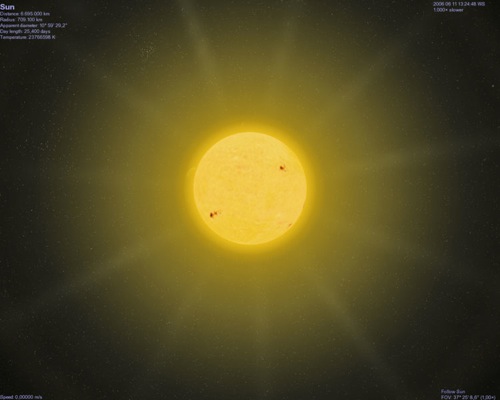
Monday is the Summer Solstice - well, Monday at 7:29am to be exact for our location. It is a special day - it is the longest day and shortest night of the year. After Monday, our days begin to get shorter again and keep doing so until the Winter Solstice in December.

With each solstice, equinox, and some of the other seasonal year markers like May Day and Halloween, I take note of the specialness of the day. It makes me feel different. It makes me feel part of something bigger and I guess I am since I am a passenger on our great Mother Earth as she makes another circle around the Sun.

Depending upon the season I celebrate the day in different ways - for May Day, I visit a park and enjoy the Spring wildflowers and the regreening of the Earth. For the Winter Solstice, I go outside at night and let the quiet stillness of Winter and the icy, twinkling stars fill me. And since the Summer Solstice is all about the Sun, I rise as early as I can to greet the Sun as it sets off to make its journey across the sky.

Our ancestors throughout history and throughout the world have also taken special note of these times as well. Not only did they take note, but they built markers, monuments, and sacred sites to note our yearly path around the sun and other astronomical events. They created giant calenders and celestial observatories made out of stone, wood, and earth - some of these surviving to our modern day.

The ancient Britons built Stonehenge, Newgrange, and others. The Mayans built the pyramid "El Castillo" at Chitzen Itza where shadows on the Fall and Spring equinoxes make the "serpent come down from the sky." And many others throughout the ages and around the world including those created by Native Americans. The picture above is of Medicine Wheel in Big Horn County, Wyoming. It is a precolumbian stone structure known as a "medicine wheel" and it is one of many such structures throughout North America that were built by Native Americans. The Bighorn Medicine Wheel is also one of these ancient stone and earth calendars. It marks the Summer Solstice as well as the rising of the stars Sirius, Aldebaran, and Rigel. And without a doubt, this site will herald in the Summer Solstice this upcoming Monday.

So while you may not have Stonehenge in your backyard or the Bighorn Medicine Wheel around the corner, the Sun will rise above your home just the same as these special places come Monday. Rise early. Greet the Sun and be thankful for the Sun's warming rays. Be thankful for being a passenger on the great yearly trip around the Sun once more. Be thankful for all the blessings that are yours. And if you have a special place in your yard or garden, take 2 sticks. Push one into the ground. And as the Sun breaks the horizon Monday morning, line up the Sun, the first stick and the second stick. Push the second stick into the ground. Later find two special rocks and replace the sticks with those rocks. They will mark not only the Summer Solstice for you all year long but the blessings you have to be thankful for as well.

-kim
Monday, June 7, 2010

Wild Strawberries - Red Ambrosia

Have you had any wild strawberries yet?

I picked some tonight and shared with my children. Mmmmm...nothing like them. Strawberries are something that "bigger is not always better" definitely applies to. The wild strawberry has so much favor and sweetness packed into that tiny red berry. Those red behemoths that you find on your grocer's shelves so pale in comparison in every way save the size.

Home-grown strawberries are better than the usual supermarket fare so if you don't have access to wild strawberries (which many don't) or your own strawberry patch, find homegrown strawberries at your local farmers' market or a U-pick farm. And I do recommend picking your own. There's nothing like harvesting your own food - whether it be wild grown or cultivated. And share the experience with the young ones in your life. Teach them about growing and harvesting food. Their life will be richer for it.

A few sweet facts about strawberries.....
  • One of the ceremonies of the Haudenosaunee (Iroquois) ceremonial year celebrates the strawberry
  • The strawberry is not a berry at all. It is an Accessory fruit
  • The cultivated garden strawberry is a cross between 2 New World strawberry species
  • Strawberry leaves make a nice tea
  • The strawberry is a member of the Rose family
  • The strawberry is the only fruit to have its seeds on the outside
  • Strawberries are grown in every state in the United States and every province in Canada
  • The US is the top producer of strawberries in the World
  • Strawberries have 9 vitamins & minerals (Calcium, Iron, Magnesium, Phosphorus, Potassium, Selenium, Vitamin C, Folate, Vitamin A) and their leaves Vitamins C and K.
  • 94% of US households consume strawberries 
  • The strawberry is recognized as representing absolute perfection in the Victorian language of flowers
  •  Strawberries have a very short season - approximately 2 weeks near the Summer Solstice
  • The wild strawberry was the first plant to colonize the rim of Mount St. Helens after its 1980 eruption
  • The strawberry is of the genus Fragaria. The word, 'fragaria' comes from the Latin word meaning fragrant
  • The strawberry plant was used medicinally in Europe and by the Native peoples of North America 
So go pick a few strawberries. And if you want them the way I like them best (other than fresh out of hand!) is to simply slice them and serve them over good vanilla ice cream.  Enjoy!

-kim

Thursday, May 27, 2010

The Planting Moon

Hopefully this day finds you in your gardens enjoying the sun and  planting seeds. Today is the "Planting Moon" and those following lunar cycles to plant, find this an auspicious day full of fecundity and vitality for the newly planted seed. 

Perhaps you know it already, but each full moon goes by many different names around the world. Many of these names indicate seasonal activities or traits of the season, such as the "Planting Moon" or the "Harvest Moon." Check out this link for a list of some the full moon names.

And if you haven't yet planted your seeds, this long holiday weekend is a perfect time. Rather than going to the beach or picnics at a park, this is exactly how I usually spend my holiday weekend - in the sun and dirt with seeds in my hands.

And if you are looking to add the littlest of the Three Sisters (beans) to your garden this year, here's a suggestion from my vegetable garden. My vegetable seeds (last year's leftovers and new seeds for the year) used to be kept in a shoebox. Well, I went past them fitting in a large moving box long ago. One of my problems is that I end up with 6 seeds of this or 12 of that leftover - not enough for a row of any thing but I save them anyways. I think there is something criminal about throwing out seeds so I never do it. But seeds don't last forever. Although outside some notable exceptions, most seeds retain decent viability for 2-3 years.

So unless you get exactly the same varieties of a vegetable each year, you'll have leftovers like me. Take those tiny handfuls of seeds from previous seasons mix them and plant a row. The most enjoyable rows of beans I ever grew were the rows of pole beans I grew the last two years where I did just this. The rows were highly productive over a long period since all the varieties mature at slightly different rates. And the mixed bean harvest had a variety of color and taste on the dinner plate.

And on that subject....if you are not already a fan of pole beans, I urge you to try some this year. Most gardeners have more desire for plants than garden space. Pole beans are an excellent producer for the small footprint they take up in the garden. They grow up, not out. You sow them rather thickly and let them climb. You don't need anything fancy or complicated for them to climb on. Long sticks and poles work just fine and hey, those do grow on trees!

Have a wonderful holiday weekend and join me (at least in spirit) in the sun and rich earth of the garden!

-kim